
Get better book launch results by taking these 9 steps while you’re writing
Make sure you get the book launch results of your dreams by laying the groundwork for it while still writing. Here are 9 steps to take.
Raise your hand if you waited until you hit “publish” on Amazon to start thinking about how to get the book launch results that author dreams are made of.
If you’re a traditionally published author, you might not have thought about it at all. You expected your publisher to do whatever was needed to make sure readers discovered your book. No need for you to get involved. (Whoops.)
You were probably disappointed with your launch results, too.
Let’s turn that around. It starts with taking specific book marketing steps while you’re still writing.
Discovery is key
I understand the challenge. It’s hard enough to find time to write the book. Making room in your schedule (and mind) for book marketing while writing might seem like too much of a challenge.
But you have to — even if it means it takes a little longer to finish writing.
If you don’t start laying the groundwork you need to sell books before your manuscript is done, your book launch results will be dismal, discouraging, and disappointing.
If you don't start laying the groundwork you need to sell books before your manuscript is done, your book launch results will be dismal, discouraging, and disappointing.Click to tweetYour book won’t be discovered on launch day or any other time of the year unless you goose the discovery process. That work starts early.
9 early steps to improving your book launch results
Here are nine steps to take while still writing that will help lay the groundwork for success.
Take on just one at a time. Fit in what you can, when you can.
If you do this, you’ll have several of your book marketing basics in place by the time your manuscript is done. That will set you up for a better, more successful launch.
1. Learn as much as you can about book marketing.
Identify the bloggers who are publishing book marketing information you can trust. Subscribe to their newsletters.
In addition to my newsletter, I recommend:
2. Get clear on who will love your book.
That’s your target audience, the people you wrote your book for.
If you’ve written a nonfiction book, your target audience is people who are interested in that topic. But what do you know about them?
Many novelists tell me they wrote the book they’d like to read. It makes sense, then, that their ideal reader – their target audience – is people who are like them. (That’s not always the case – it’s just an example.)
3. Research your target audience.
Learn as much as you can about the person who is most likely to buy your book.
This will help you visualize your audience “avatar” – the one individual who best represents those who will love your book.
Next, do more research to learn where you’ll find them online and offline. For example, do people in your target audience use TikTok? Will you find them on LinkedIn? Do they like Pinterest?
4. Build a following on the social network that most of your audience uses.
Your research into your target audience helped identify where you’ll find them online. Select one or two social networks that are most popular with your audience and learn how to use them effectively.

After you’ve spent some time learning how they work, start following “the right” people there.
Try this: Find the most popular authors in your genre. Follow them, and follow the people who follow them, too. (If they like the types of books the category leader writes, they’ll be interested in yours, too.)
And, of course, share content that will interest your ideal readers.
5. Connect with bloggers.
Virtual book tours (author blog tours) are common and popular book launch elements.
When you “go” on a virtual book tour after your book is published, you’ll ask bloggers who reach the people you want to reach to share content that’s related to your book. That might be a:
- Guest post
- Q&A
- Audio or video interview
- Book review
You will be far more successful with bloggers who already know who you are. So, after you’ve identified the blogs you’ll want to visit on your tour, comment on and share their posts regularly.
They’ll notice you.
6. Build an email list.
Start gathering email addresses now. This is a never-ending process and for many, that growth is slow. So don’t wait.
Be sure to offer a downloadable gift – a “lead magnet”– in exchange for each email address. (Get ideas for fiction lead magnets and nonfiction lead magnets and learn how to create them at those links.)
Learn how successful authors use email to communicate with their readers by subscribing to their newsletters. What do you like about their approach? What do you dislike?
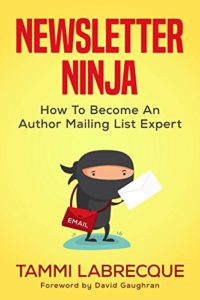
I also recommend reading Newsletter Ninja: How to Become an Author Mailing List Expert.
Learn how successful authors use email to communicate with their readers by subscribing to their newsletters.Click to tweet7. Compile a list of “key influencers.”
Who is most influential with your book’s target audience? You’ll want to ask them to endorse your book after the manuscript is polished and finished.
Begin gathering names and contact information for them now. That’s all – just figure out who they are and how to reach them, and save it all in a file.
8. Create a Facebook Page.
I’m not talking about a Facebook profile – that’s your personal account where you acquire “friends.” I’m referring to a business Page where you acquire “likes.”
You’ll need a Page to advertise on Facebook, but it’s also a good way to establish your book’s presence on this popular social network without annoying your friends.
Use it to solicit opinions on your book’s topic, share progress updates, ask fans to vote on cover options, and so on.
9. Add your book title to your e-mail signature.
It doesn’t get any easier than just typing “Author,” followed by your book title.
Need more help? “The Ultimate Book Launch Timeline & Task Checklist” printable PDF I created for you offers a simple, step-by-step timeline and checklist so you know exactly what to do — and when — during your book launch. Plan your launch with confidence using this tool for fiction and nonfiction authors alike that helps you focus on what matters most — without overwhelm. Get the details at https://buildbookbuzz.gumroad.com/l/booklaunch
Which one of these will you start doing today? Will you pick the easiest or the hardest?
Do what works for you, but whatever you do, be sure to do it now.
What’s the most important thing you did before you launched your book? Please tell us in a comment.
Like what you’re reading? Get it delivered to your inbox every week by subscribing to the free Build Book Buzz newsletter. You’ll also get my free “Top 5 Free Book Promotion Resources” cheat sheet immediately!

G’day Miss Sandy.
I have maybe 2 of those 9 under control. Launching is a push-pull, a “hurry up and wait.” Maddening, because you’ve got extreme exuberance about your almost-finished book—and that palpable excitement is your best marketing asset—but you must pace it out so a) you b-u-i-l-d excitement in others, and b) you and your book are truly ready on D-day. (Not “Okay, good enough, let’s publish.”)
My personal writer police say: 1) Select a launch date way, way farther out (several months or more) than you think the book will be ready. That gives you breathing room to both improve the book and stoke the crowd, and takes the pressure off. 2) Don’t feel ashamed or shy about promoting. At this point in internet evolution, everyone understands what you’re doing and why (it’s not frowned upon). (Frowners are probably envious.) You just have to keep the style and voice they love in your books, i.e. be yourself and have fun. 3) Have realistic expectations. Mine are usually that this launch should be bigger than the last (more sales), I might try a new tactic or two, and I’ll learn stuff. With more lead time, I wasn’t frantic this time (with “Nicaragua Story—Back Roads of the Contra War,” out July 7!!) about updating my website, whipping that ornery ebook into shape, chatting with Author Central and KDP, and tons more. I even threw some last-minute yellow bananas on the back of my blue cover! 4) There WILL be snafus! You’re okay if you have that extra time. 5) Gospel: you may not get the feedback, sales, and accolades from whenst or whomst you thought—support can be random and pops in unexpectedly, often from strangers—but it’s all good. And you continue accumulating true loyalists as you add more books. 6) KNOW you can’t do it all, and that certain marketing avenues won’t appeal to you. For example, I’m letting Pinterest slide for the moment because it seems less user-friendly to me now, and I never mastered selling there. Things shift. 7) I totally accept that I’m not and never will be like marketeers making healthy livings on sales and promotion—not what I do, not who I am. Y’gotta believe in your own thang.
I’ll also add, tangentially, that it saddens me to see self-pubbers trying to imitate other authors, from covers to story-lines to marketing approaches. Yes, we need guidance, but part of the glory of self-publishing is that you can do what you want, be as creative as you please, be zany and free. It’s such an exciting venue to push limits—with finesse, of course.
Well, hey there, Miss Wendy! This is great info., as always. I especially love your recommendation that you set a launch date that’s farther out than what you think you need at the moment. As you noted, it allows time for you to deal with issues — and there WILL be issues — and reduces your stress level. And in most cases, that launch date is arbitrary, anyway.
To your last point, I think that many self-published authors need to play follow the leader because they need that “template” approach. They need a blueprint to follow because they don’t have the background or experience that you have at this point to wing it. Case in point: I’ve seen a few “there are no rules” book descriptions that left me confused about the book’s category, topic, you name it. There are some standards you really should adhere to, especially when you’re a beginner. Readers have certain expectations and when you don’t meet them, they’ll move on to another book that does.
Thank you!
Sandy
Yeah, I totally hear you. Formatting’s huge in this. You can’t mess with it. And you’re absolutely accurate that, with time, comes knowing where you can branch out and stretch yourself, and where you SHOULDN’T.
Agreed, too, that—particularly in writing—being zany and off-beat can really destroy your story, and lose readers. Because you’re giving yourself license to go uncensored, unedited. Thanks for pointing that out, because in books we kinda hate that off-the-cuff, “I’m so original” flare. Like, no, murder those deplorables. I guess I meant it in a more sedate, knowing the medium sense….like, now that I understand this, where can I take it higher? Thanks for the clarification, very important point!
[because in books we kinda hate that off-the-cuff, “I’m so original” flare] Yes! This is exactly what I meant. I can think of one recent example where the author took on an “I can break all the rules because I am ME! I am SPECIAL!” and it didn’t quite work out as the person hoped.
And I appreciate the clarification on what you meant. I love the idea of taking it higher. Brilliant! We all need to continually challenge ourselves to move to the next level.
Thanks!
Sandy