
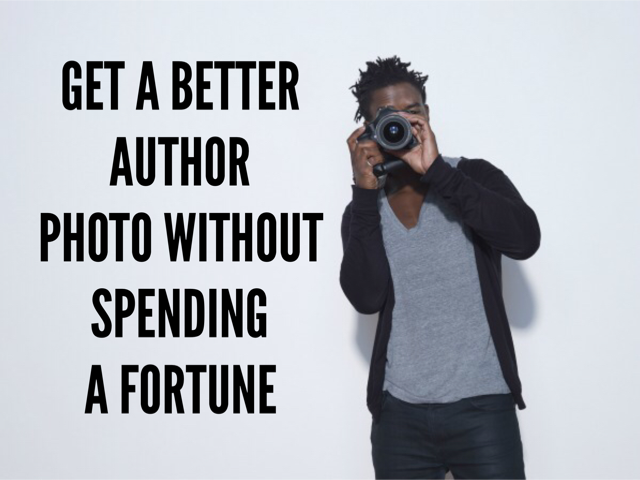
Get a better author photo without spending a fortune
You need to get a better author photo. You don't have to spend a small fortune, though. Here's how to make it more affordable.
Raise your hand if you’ve seen a bad author photo on a website or social media profile recently.
My hand is up.
I’ve seen photos where the author is just staring into a webcam. No smile. No warmth. Just a stare. (And come on. A webcam?)
Then there are the smartphone selfies. (What adult has actually mastered the art of the selfie?)
Selfie or not, sometimes you can tell that another person has been (not completely…) cropped out.
Other times, the author is joined in the photo by someone else — usually a spouse — who isn’t cropped out.
If your author photo is bad, is your book bad, too?
These amateur photos are certainly more affordable than professional head shots, but they aren’t very useful. The author might as well be saying to readers, “Quality isn’t important to me.”
Put another way: When readers see that you don’t care enough to use a quality head shot, they might think you don’t care enough to write a quality book, either. Who’s going to take a chance on a book that might be subpar at best?
I’ve said it before: Quality counts. You need to write a better-than-good book. And you need to present yourself to readers as a writer who cares about getting things “right.”
Signal that to your audience by ensuring that every reader encounter — on social media, on your website, and in person — says “I’m giving you the best I’ve got.” Your headshot is the centerpiece of that, since it follows you everywhere you appear.
So it had better be good.
Yes, you have to spend money to get a high-quality professional author photo. Many authors are reluctant to do that, while others simply don’t have the money for it. Money can be an obstacle, but there might be a way around that.
Know what you want in an author photo
Before considering how to make your improved and affordable headshot happen, get clear on what you want in a final image.
Study a wide selection of author photos. What do you like about them? What do you dislike? Saving them to a Pinterest board will make it easy for you to compare them side-by-side.
You can share that board link with your photographer, too. That will let them focus (pun intended) on the best-for-you angles and settings.
Photofeeler, a site that lets users solicit feedback on headshots, reports that people prefer images where your eyes are visible — so no sunglasses — and that show teeth in a smile.
Once you know what look you want to achieve, you can take a few different approaches to getting a headshot that does you (and your book) justice:
- Work with a photographer
- Collaborate with a friend
- Use artificial intelligence (AI)
Here’s more information for each.
Your #author headshot should be as good as your book. Here's why plus affordable "I need a new headshot" options that make it possible.Click to tweetSpend less on a photographer
Here are four ways to get a headshot that’s better than the do-it-yourself option but less expensive than paying full price at a studio.
1. Barter with a photographer.
Bartering involves swapping services.
What do you do well that can help a professional photographer? You can also ask the photographer what they need help with and then figure out how you can contribute in a way that makes a service swap fair.
You might write a few marketing newsletters, shop for props, or serve as a baby wrangler on a shoot.
2. Offer to model for a photography class or workshop.
Offer to model in exchange for images from all the students.
Give aspiring photographers practice that helps expand their portfolios so you get an image collection representing a range of perspectives and styles.
3. Hire a photography student at a discounted rate.
Students don’t expect to be paid top dollar, but they deserve to be paid for their time. It’s an incentive for them to do their best.
What if you don’t like the beginner’s photos? Discuss that in advance. You might be able to negotiate to pay only if you’re happy.
4. Get it done at a writer’s conference.
I’ve paid for discounted headshots at the American Society of Journalists and Authors (ASJA) annual conference in New York City for close to two decades. Participating photographers discount their fees because they can pack their schedule with back-to-back on-site shoots.
This is typical of writer’s conferences in general. If you plan on attending one, be sure to check the schedule to see if this service is offered as an add-on.
Get help from a friend
You can also take the almost D-I-Y approach. “Almost” means you’ll need help for this.
Who do you know who consistently takes great smartphone photos? You know who they are — you regularly comment on Facebook or Instagram that you love their photos. This is someone who knows their way around a phone camera. And it’s someone you want to enlist.
If they haven’t done this before, a Google search can help both of you learn how to get the best image possible. You’ll want to learn about lighting (natural light is best; I prefer headshots taken outside), appropriate apparel, and the most appealing poses. Practice those poses in advance.
Your photographer will want to read up on the best approach for the smartphone they’re using (for example, “portrait” mode works well with an iPhone) for both shooting and editing images.
Hubspot offers advice in “How to Take Your Own Professional Headshot: A Budget Friendly Guide;” Snapbar shares tips in “Top 5 Tips for How to Take a Professional Headshot at Home.”
Use an AI tool
There are a number of AI tools that can generate a professional-looking headshot, but you still need a photo to start with. You can get a friend’s help with that “starter” photo as outlined above or take your own photo — aka a selfie.
I found these instructions and the corresponding demo video for using Google’s Gemini from LinkedIn HR leader helpful.
A Google search for the best AI headshot tools turned up several articles, all produced by… of course… AI headshot tool providers. Each company ranked its own resource at the top, of course, but even biased information can be helpful.
Check out “5 best AI Headshot generators HONESTLY rated” and “We tested Top 8 Best AI Headshot Generators.”
Canva has a free tool, but when I just tested it, it was too glitchy to recommend with enthusiasm.
My favorite resource remains Adazing’s Author Headshots because it’s designed specifically for an author’s photo needs. I was fortunate to get it during the introductory discount period and have gotten a lot of use from the images generated.
Put that great author headshot to work
Now that you’ve upgraded your look, remember to use the same headshot for all social media profiles and everywhere you are online, including your website and its media/press room (learn more about that in “Must-have online press room elements for authors and books“).
Your author photo says a lot about you. You want it to say the right things.
Author headshot FAQs
1. Why does my author photo matter so much?
Your author photo is part of how readers judge your professionalism.
When they see a low-quality image, they may assume you don’t care about quality — and that can extend to how they perceive your book. Every reader encounter should signal, “I’m giving you the best I’ve got,” and your headshot is a big part of that.
2. What makes an author photo look unprofessional?
Common issues include staring into a webcam without warmth, awkward selfies, poorly cropped images, or photos that include someone else who shouldn’t be there. These kinds of images don’t present you — or your book — in the best light.
3. What should I think about before getting a new author photo?
Start by getting clear on what you want.
Study other author photos to see what you like and dislike, and consider saving examples to compare. Pay attention to details like visible eyes and a natural smile. Knowing your preferences will help you (and your photographer, if you use one) create the right look.
4. How can I get a better author photo without spending a lot of money?
You have several options: barter services with a photographer, model for a photography class, hire a student at a lower rate, or get a discounted headshot at a writer’s conference.
You can also work with a friend who takes great smartphone photos or explore AI tools that generate professional-looking images using a starter photo.
5. Once I have a good headshot, how should I use it?
Use the same photo everywhere — on social media, your website, and your online press room. Consistency helps reinforce your professional image and ensures that your author photo is working for you wherever readers find you.
Have you seen a great author photo? Please share a link to it in a comment.
Like what you’re reading? Get it delivered to your inbox every week by subscribing to the free Build Book Buzz newsletter. You’ll also get my free “Top 5 Free Book Promotion Resources” cheat sheet immediately!

Great article, Sandra! Such a good thing to do, because authors will be asked over and over for their picture. Better to have one you are happy to send out.
I used Thumbtack – https://www.thumbtack.com – to find a local photographer. This site was so easy to use and I was able to read reviews on the photographer, choose how far I was willing to drive, and designate how much I would spend. Usually you’ll have a few people respond, but I only had one which made it easy – mine had all 5 star reviews and a ton of them.
Like so many, I do not enjoy having my picture taken, but a professional can put you at ease. I wasn’t going to put the picture in my book, but was having them taken just for media use, but they came out so well I put in the book too.
What a great tip for finding a photographer, Martha! Thanks! I don’t like having my picture taken, either, so it really helps to work with a photographer who helps me relax. I’m glad you’re happy with yours.
Sandy
It is high time someone tackled this issue for authors. Thank you!
You’re welcome, Ginger. I’ve seen some scary ones. Have you? I don’t like to include bad examples, though, because I think that’s kind of mean.
Sandy
I’m fortunate enough to have a friend who is a photographer. She came over for some tea, and we must have taken about 300+ pictures and only come up with a few that worked. We tried indoor and outdoor shots. I’m not photogenic, so I practice smiling in front of the mirror before I’m photographed. I sometimes do this thing when I squint one eye more than the other… Try not to squish your face too much. My friend also had me practice “the turtle” — extend your neck. It feels uncomfortable, but it looks good. There is also Tyra’s famous “smile with your eyes” — smile and notice how your eyes feel, keep that feeling in your eyes, but tone down the smile (so you do not have weird wrinkles). Consider what is your best feature. If the beast feature is the smile, go for it. In my case, my eyes trump everything else.
I would suggest to have different outfits ready (you do not want to blend into the background, but you also do not want your shirt to be more visible than your face) and to consider what the photo will be used for. I needed a professional photo for a November book fair. At the time we were taking the photograph, my neighbour had a yard full of poppies (a Remembrance Day symbol).
I did not wear glasses and my teeth are not showing, but the photo we chose feels like me. I don’t know if I’ll ever take a better one.
It looks good as a 1:1 head shot, and a 2:3 portrait.
Catia DaCosta’s studio is CDC Photography.
I love these tips, Mili! Thanks!
Sandy
You’re welcome, Sandy.
Make very sure that you have the rights to the photo which will allow you to use it as you wish. Being sued for copyright infringement or having to pay to use your own picture stinks.
Thanks, Marilynn. Has that happened to you?
Sandy
Great article. I have a question. I write both fiction (historical) and also nonfiction/how-to books. I plan on wearing a vintage dress for my fiction book author photo, but don’t think it would be a fit for the back of my nonfiction (Kickstarter) books.
Your article said to use the same photo. Would that rule still apply in this case?
Thanks, Patrice. You’re correct — your photo in a vintage dress wouldn’t work for your nonfiction, but your nonfiction photo would work for your historical fiction. You can definitely use two different photos, but I’m not sure why you’d want to.
Sandy
Yes, I just want a more fanciful one for my fiction stories. Thanks for the reply.
I’m sure you’ll have fun with that photo shoot!
Sandy