
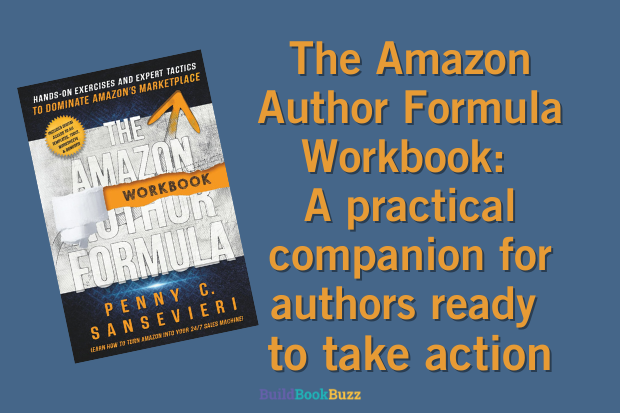
The Amazon Author Formula Workbook: A practical companion for authors ready to take action
Will The Amazon Author Formula Workbook help you finally get your act together on that platform? This review will help you decide.
Affiliate Disclosure: This post contains Amazon Associates links. As an Amazon Associate I earn from qualifying purchases. That means if you click on them and make a purchase, I will receive a couple of pennies (at no extra charge to you).
Last year, I reviewed The Amazon Author Formula: Insider Tips, Tricks, and Strategies for Selling More Books! by Penny Sansevieri. It’s a smart, strategy-focused guide for authors who want to understand how Amazon really works—and how to work with it, not against it.
Now Penny has released The Amazon Author Formula Workbook: Hands-on Exercises and Expert Tactics to Dominate Amazon’s Marketplace, a companion tool designed to help authors do what many struggle with after reading a marketing book: actually implement what they’ve learned.
Before I go further, full transparency: Book publicist Penny Sansevieri, founder of Author Marketing Experts, is a friend and colleague whose work I respect. As always, though, this is a neutral review written with what will or won’t help you in mind.
Why a workbook makes sense
If you read the original book, you know it covers a lot of ground—from keywords and categories to covers, descriptions, pricing, reviews, and Amazon ads. That breadth is valuable, but it can also feel overwhelming.
The workbook’s job is to slow you down and walk you through applying those concepts to your books.
Each section of the workbook corresponds to a chapter in The Amazon Author Formula, with worksheets and prompts that help you evaluate what’s working, what isn’t, and what needs attention next.
But… neither the original book nor The Amazon Author Formula Workbook includes chapter numbers. The book chapter titles don’t always line up with the workbook titles, either. Because of that, and because I read the original book a year ago, I’m struggling to match the workbook’s worksheet titles with the book’s content.
For example, there’s a helpful workbook section title, “Who Are Your Target Readers,” but there isn’t a corresponding section identified in the first book’s table of contents.
Maybe I played a matching game with my preschooler grandson too much over the holidays, but I’d like everything to be more matchy-matchy. I think it would make the companion workbook more… well… companionable.
Will book publicist Penny Sansevieri's Amazon workbook for #authors help you sell more books on that powerful site? This review will help you decide.Click to tweetWhat’s inside the workbook
Matchups aside, the workbook is substantial and comprehensive. It includes worksheets and planners that guide you through:
- Assessing your Amazon relevancy score and overall book alignment
- Evaluating keywords, categories, and metadata
- Reviewing pricing, covers, and retail pages
- Tracking reviews and managing long-term optimization
- Planning launches and promotions
- Analyzing and refining Amazon ads
- Strengthening your Author Central presence
- Building a sustainable, long-term Amazon strategy
What I particularly like is that many worksheets encourage tracking over time. This reinforces an important truth about Amazon marketing: It’s not a one-and-done activity. Ongoing monitoring and adjustment matter.
I keep tweaking. You need to do it, too.
Print workbook or spreadsheet? You get both
One feature that will appeal to many authors is flexibility in how the workbook can be used.
The print version allows you to write directly in the book if you prefer working on paper. (That’s me.)
But The Amazon Author Formula Workbook also includes a UPC code that gives you access to a downloadable spreadsheet version of the worksheets. That option lets you type directly into the file, save your work, update it as things change, and keep everything organized digitally.
For authors who dislike handwriting—or who want searchable, editable records of their work—the spreadsheet option is a real plus.
I’m not a spreadsheet kind of gal, and yet, I found the file and corresponding instructions surprisingly useful. Still… the Excel file doesn’t include everything that’s in the print workbook (the format I’m reviewing). The target reader section, for example, isn’t in the spreadsheet.
Think of it as a companion to the workbook, which is a companion to the original, full book.
Who will get the most from this workbook?
It’s best suited to authors who are serious about improving their performance on Amazon and are willing to do the work.
If you enjoyed The Amazon Author Formula but found yourself thinking, “I know what I should do, but I’m not sure where to start,” the workbook solves that problem. It provides structure, order, and prompts that keep you focused.
That said, this isn’t something you’ll flip through casually. To get value from it, you need to commit to using it alongside the original book. Think of the book as the strategy and the workbook as the execution plan.
Do you need both the book and the workbook?
In my opinion, yes.
After I read the book last year, I told Penny she could add even more value by creating a companion workbook. It was already in the works!
So, obviously, I think buying both makes the most sense.
The workbook is designed as a companion, not a standalone resource—although you can use it that way.
It assumes you’ve read—or are reading—The Amazon Author Formula and want help applying its lessons. Authors who are truly committed to maximizing their impact on Amazon will benefit most from using the two together.
Can you use the workbook if you read the original book months ago?
You can.
You know by now where you need to put the effort. When reading the book last year, I took notes on where I should improve my Amazon page. I can refer to those notes now and take advantage of the right worksheets in the workbook.
It might be easier, though, to read (or re-read) the book with the workbook in hand for maximum value.
Turn ideas into action
The Amazon Author Formula Workbook does what a good companion workbook should do: Turn ideas into action.
For authors who want a hands-on, organized way to implement Amazon marketing strategies—and who appreciate the option to work either on paper or digitally—it’s a useful and comprehensive resource.
If you haven’t read the original book yet, I recommend starting with my review of The Amazon Author Formula and then deciding whether the workbook makes sense for you. If you have read it and are ready to put those strategies to work, you can check out The Amazon Author Formula Workbook and see if it fits your needs.
I recommend the print version rather than the e-book. It’s a more useful format for a workbook.
Finally, while my difficulty matching worksheets to book content frustrated me, I still think you need this resource. Rather than pay hundreds of dollars for an online course, buy Penny’s excellent training in book form.
It’s a fantastic value. But the real value comes from what you do with it.
If you’ve used the companion workbook, please tell us in a comment how it’s helped you.
Like what you’re reading? Get it delivered to your inbox every week by subscribing to the free Build Book Buzz newsletter. You’ll also get my free “Top 5 Free Book Promotion Resources” cheat sheet immediately!
