
Author marketing scams v. 2026: What to watch out for, how to keep your money
Discover 3 author marketing scams v. 2026, how they work, what they look like, and how to make sure you don't fall for them.
Have you received an email informing you that a not-local-to-you book club wants to read your book and discuss it with you?
Or a message that accurately summarizes your book and suggests you work with the sender to market your book using specific tactics they briefly outline?
Maybe you got a flattering email from a well-known author such as Margaret Atwood or Freida McFadden.
Author scams abound
If so, you are not alone.
Countless authors – including me – are steadily receiving emails fitting one, two, or all three of these descriptions.
And, as much as any author would want to believe that members of a London book club so, sooooo want to read their book about how to turn a squirrel into a house pet, they don’t.
Telling you so is a lie. And the lies are being perpetrated by scammers using artificial intelligence (AI) to separate you from your money in exchange for nothing. AI is helping the bad guys craft personalized messages hitting all the right points – which makes them quite convincing.
Even The New York Times is reporting on these newest predators. (That’s a gift link so you can read it without a subscription.)
How to spot scammers in your inbox
Rather than go into great detail about how these next-level, AI-enhanced scams work myself, I’m linking below to what others have written about them. I’d rather discuss how to avoid getting sucked in by these and others that will no doubt begin showing up.
Frankly, the safest way to protect yourself is so simple: Stop being so easily flattered.
Really. It’s that easy.
Well, actually, it’s a two-step process:
Step 1: Ask yourself, how likely is it, really, that your book with just seven Amazon reviews is suddenly so popular?
Most of us aren’t in a position to brag about steady, high-volume book sales. Yet, we’re suddenly inundated with book club appearance requests or unsolicited book marketing service pitches.
There’s something fishy – and phishy – going on here.
Step 2: Delete the emails.
No need to post on Facebook about it to learn what others think.
It’s not necessary to forward the message to an author friend for an opinion.
You don’t even have to do a Google search to see if the book club exists or ask ChatGPT what it thinks about the message.
Delete it and move on.
Please take this advice seriously.
I’m seeing too much advice about this online that says things like, “Contact the famous author through their website and ask if they sent the message.”
Um, no.
That wastes their time and yours.
Others suggest checking the sender’s email address because if the sender uses a Gmail address, the message “might” be a scam. No need to do that. It is a scam.
With ego tucked aside and the garbage cleared out of your inbox, you’ve got more time to focus on what you do best: writing.
Author marketing scams v. 2026
Here’s what some in book publishing are saying about the three most recent scams hitting your inbox.
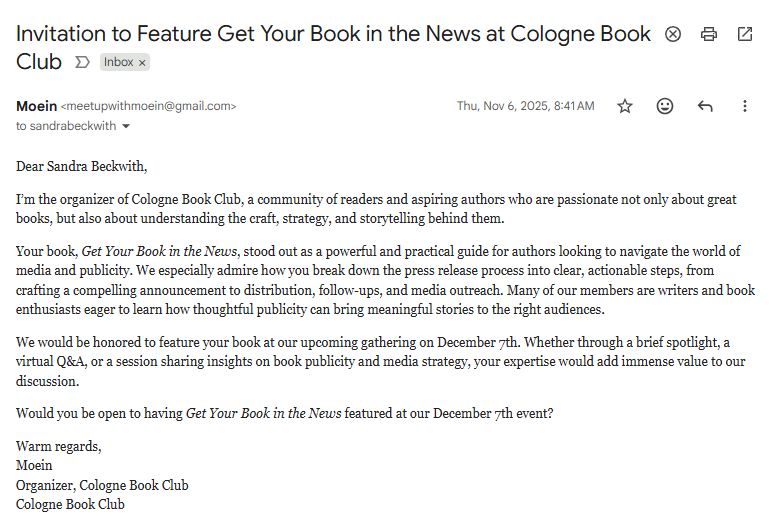
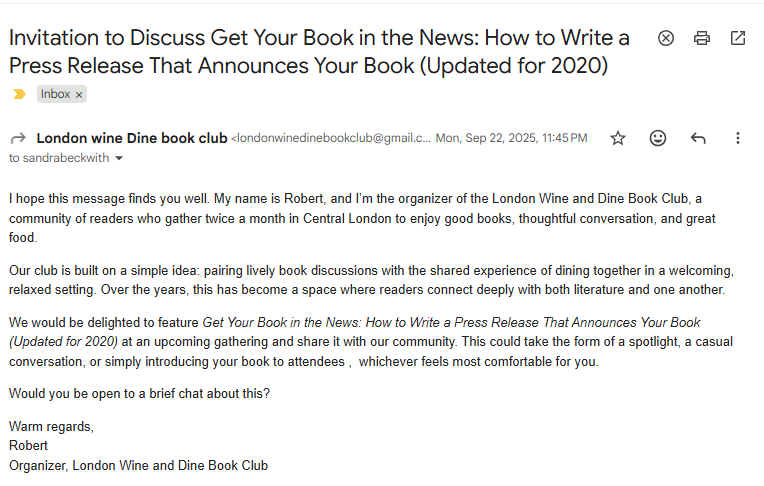
Scam 1: Book club appearance invitations
These articles document the now-common “book club invite” scam where organizers gush about your book, then pivot to fees (spot fees, admin fees, “packages,” etc.).
Here are a couple I’ve received.
Return of the Nigerian Prince Redux: Beware Book Club and Book Review Scams from Writer Beware
By including email screenshots, this article will help you recognize well-crafted scam messages when they drop into your inbox.
This includes lots of general advice and information. For details related to this specific scam, scroll down to 3. Common Author & Self-Publishing Scams Happening Now.
Genre Grapevine: Book Club Scams Are a Warning of Emerging AI Super-Scams from Jason Sanford
In this newsletter article, author Sanford walks through an email from a supposed curator of a 2,000‑member club and shows how it escalates into paid “spotlight fee” packages for appearances. I love that he discovered that even the headshot linked to the sender’s Gmail account was AI-generated.
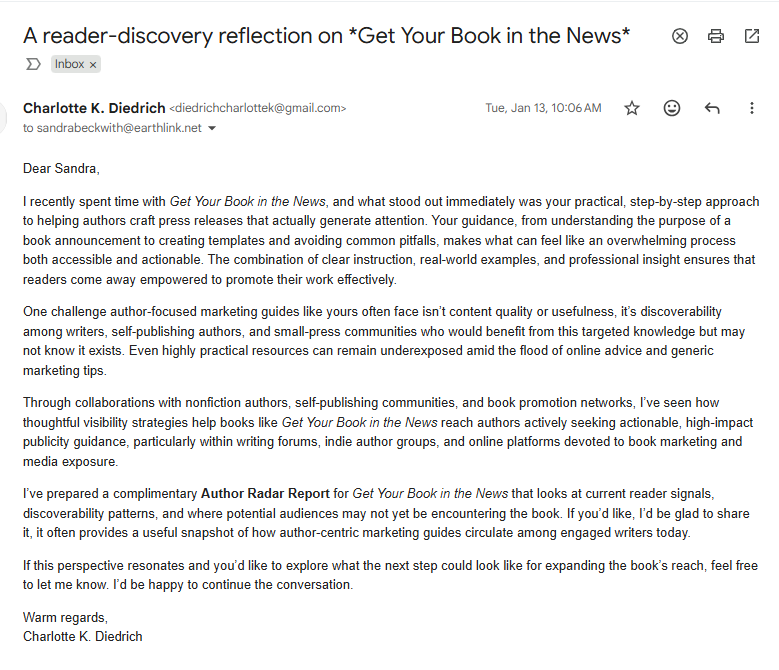
Scam 2: “I adored your book and can run a targeted campaign”
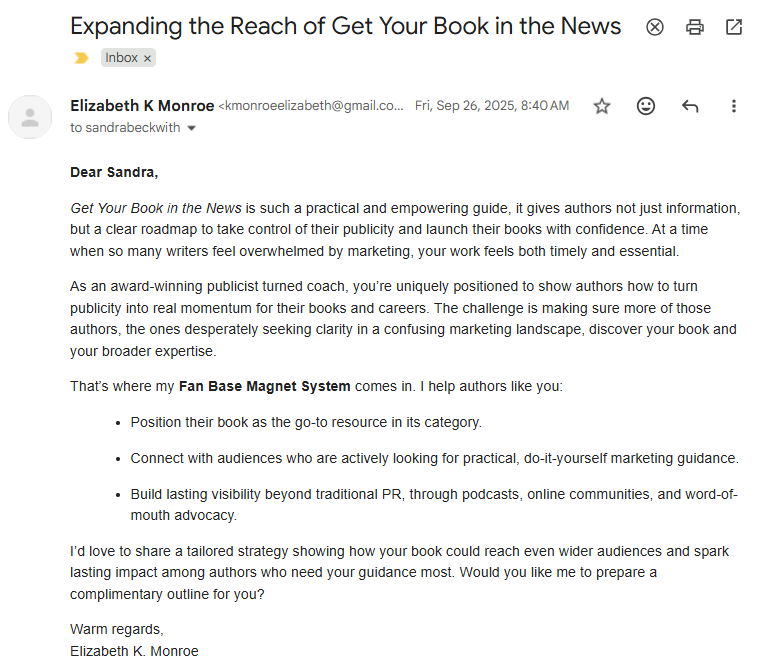
Several warnings now flag book marketing and publishing services scams that consistently use generic Gmail accounts instead of verifiable, branded domains. These messages, often with details about how to improve your marketing, push pricey marketing packages that don’t really exist.
Here are a couple of those messages from my inbox.
Update on those Flattering AI Book Marketing Scams from Anne Allen
As author Allen points out, “These scammers wouldn’t be so relentless unless this stuff is working.” (While you’re there, subscribe to the blog using the form on the right. Anne and Ruth Harris offer excellent content.)
Return of the Nigerian Prince: A New Twist on Book Marketing Scams from Writer Beware
Victoria Strauss provides a thorough breakdown of how this prolific scam works. Please take the time to read it because it will help you spot future scams.
That Personalized Email About Loving and Marketing Your Book Is a Scam from Electric Lit
In this December article, Samuel Ashworth shows how the scammer pretends to offer specific services (Goodreads list optimization, book manager and authors’ advocate) while routing payments to dubious third parties. (I’ve received the Goodreads Listopia optimization email, too.)
Scam 3: Impersonation DMs and emails from “famous authors” that butter you up
With these impersonation scams, fraudsters pose as well‑known authors, send flattering messages, and use that trust to steer writers toward bogus paid services.
Novelist Teri Case shares the email she received from “Colleen Hoover” and offers scam-spotting advice.
“Celebrity Author” Impersonators Are Fooling Unwary (Real!) Authors from Writers Weekly
You’ll learn that scammers use social media direct messages as well as the telephone to try to trick you. The article links to other important information sources on the site, too.
If a Famous Author Calls, Hang Up: Anatomy of an Impersonation Scam from Writer Beware
Writer Beware’s impersonation‑scam breakdown shows scammers posing as high‑profile authors and then “recommending” specific agents, editors, or marketers. They’re all con artists in the same scam network.
Don’t be a victim
Even in situations when your book is enormously popular, remember that quality service providers don’t cold call or use social media to reach a successful author.
Whether it’s one of the three scams outlined here or another common ploy that offers to turn your book into a major motion picture, don’t take the bait.
You’ve worked hard to bring your book to life. Don’t let a cash-sucking predator ruin the fun. (And never, ever pay anybody in bitcoin.)
Current author scams FAQs
1. How can I tell if a book club invitation email is a scam?
If a not-local-to-you book club gushes about your book and then pivots to fees — such as spotlight fees, admin fees, or appearance “packages” — it’s a scam.
These messages are often AI-generated, highly personalized, and very convincing. If your book has modest sales or just a handful of reviews and you’re suddenly inundated with invitations, that’s a red flag.
Best to delete the email.
2. What’s the safest way to handle suspicious marketing or book club emails?
Don’t overthink it.
Don’t post about it on Facebook, forward it to a friend, Google the organization, or contact the supposed sender. Simply delete the message and move on.
The easiest way to protect yourself is to stop being flattered and recognize how unlikely the scenario really is.
3. Are book marketing service emails from Gmail addresses legitimate?
Usually not. Warnings now flag book marketing and publishing service scams that consistently use generic Gmail accounts instead of verifiable, branded domains.
These emails often praise your book and outline marketing tactics, then push expensive packages that don’t exist. There’s no need to analyze the email address further — it’s a scam.
4. What are impersonation scams involving famous authors?
In these scams, fraudsters pose as well-known authors, send flattering emails or direct messages, and then steer you toward bogus paid services.
They may recommend specific agents, editors, or marketers who are all part of the same scam network. Some scammers even use AI-generated headshots to appear legitimate.
If a “celebrity author” contacts you out of the blue, it’s a scam.
5. Do legitimate publishing professionals cold call or message authors?
No. Even if your book is enormously popular, quality service providers don’t cold call or use social media to pitch services to successful authors.
If someone contacts you unexpectedly offering marketing help, paid appearances, or even to turn your book into a major motion picture, don’t take the bait
Need a book marketing coach to help you determine where to put your effort and guide you around obstacles that include marketing and publishing scams? I can help! Learn more here.
Have you received any of these emails? Tell us about your experience in a comment. The more we talk about these things, the better informed we all are.
Like what you’re reading? Get it delivered to your inbox every week by subscribing to the free Build Book Buzz newsletter. You’ll also get my free “Top 5 Free Book Promotion Resources” cheat sheet immediately!

Thanks for this detailed post. It’s quite helpful and every author should read it. I’ve received so many of these emails. I’m an author and a journalist. The journalist side of me alerts me to the fact that these emails are scams.
I’m glad it’s helpful, Michele. Please feel free to share it with your author network so we can alert more vulnerable people.
Sandy
I agree with Michelle. All authors should see this, and Victoria Strauss’s blog. I subscribed to Writer Bewate some years ago and haven’t regretted it.
I receive these emails several times a day. Usually they are for marketing, but I recently received one saying my book was ideal for a film.
I block them, and delete them, but they are never-ending.
Thanks, Vivienne. Writer Beware is a wonderful resource for authors.
As for those film offers, they’re hard for so many to resist, aren’t they? People so desperately want to believe that their story belongs on the big screen. Sigh.
Sandy
Thanks I ‘ve had three or four of these – thought they were scammy. Thank you for the head’s up!
You’re welcome, John! It almost seems like an author hasn’t “made it” yet until they receive at least one of these, right? : )
Sandy
I was scammed last fall for $2K from a fake book marketer. I fought back and got my money back, as well as shutting down their fake website and Facebook profile. I’ve documented my journey in a book.
I will add a link to this article to my authorsagainstscammers Facebook page.
I’m glad you got your money back, Rae!
Sandy
Thank you so much! This is so helpful. And wow, the letters you received seem so real. I get so many book emails daily and now I know to be aware. I’m not sure I’ll be writing another book and I’m at the point I want to unsubscribe because my inbox is full with them every day. Most are offering different zoom free seminars but later followed up by things to purchase. Appreciate the heads up. Thanks for taking the time to share with authors.
I’m glad it was helpful, Marsha. I’m sure most of your emails — including the free training webinars — are legitimate. The emails you can quickly delete are the ones that use flattery to lead you along. (And yes, they ARE written pretty well thanks to AI, aren’t they?!)
Sandy
Thank you, Sandra, for your no-nonsense advice. I get at least one of these every day. At first I was so flattered. Then I got another in a day or so, then another, and they kept coming. Luckily I’m suspicious by nature and never fell for any of them. I have received ones that mixed up a title of one of my books with another author and vice versa (their titles with my name). They are becoming so sophisticated, though, that sometimes I wonder if the Gmail address could possibly be legit, especially the ones that purport to be from small book clubs that look to be real, e.g., with Facebook pages. But then I realize having a FB page doesn’t mean anything either, and the photos could all be stock photos or generated with AI. It’s so disheartening.
Leah, I think it’s very likely that the book clubs exist, but the people who says they represent them aren’t. So that FB page does belong to an actual book club, but the person who contacted you has nothing to do with them. And that’s why these scams can succeed — you Google the club and see that it’s real, so you think that the club is truly interested in your book. It’s next-level nonsense, isn’t it?
Sandy