
AI prompts for book marketing: How to ask so you actually get what you need
Challenged to get the results you need when using an AI tool? Here's how to craft a productive AI prompt for book marketing.
By now, you’ve probably heard that AI tools like ChatGPT and Claude can help with book marketing.
Maybe you’ve even tried one.
And maybe — like a lot of authors — you stared at the screen thinking, “I don’t understand why everyone’s raving about this.”
Was the output too generic? Maybe a little flat? Perhaps it was nothing like the way you actually write or talk about your book.
Here’s the thing: It’s not the tool. It’s the prompt.
What’s an AI prompt?
A prompt is simply the instruction you type into an AI tool.
And the quality of what you get back is almost entirely determined by the quality of what you put in.
Think of it this way: AI tools are like a brilliant new assistant who started today. They’re smart and eager, but they know nothing about you, your book, or your readers — yet. Your prompt is how you bring them up to speed.
The good news? Writing a great prompt isn’t hard once you know what goes into one. Here’s what I’ve found makes the biggest difference.
#Authors, are you challenged to get the results you need when using an AI tool? Here's how to craft a productive AI prompt for book marketing.Click to tweetWhat makes a good AI prompt for book marketing
I asked Claude for advice on creating a prompt that will create the kind of response you need. Here’s that advice plus mine, based on my trial and error experience.
1. Give context or background first.
Before you ask for anything, tell the tool what it needs to know. That means your book’s genre and topic, your target audience, your tone, and your goal for this particular piece of content.
Weak prompt: “Write a social media post about my book.”
Stronger prompt: “Write a Facebook post for my cozy mystery novel aimed at women over 50. The book features a retired librarian sleuth, and the tone is witty and warm. I want readers to feel curious and a little charmed.”
The more relevant context you provide, the less generic the output.
2. Be specific about what you want.
Tell the tool exactly what you’re asking for — format, length, platform, and purpose.
“Write some tweets” leaves too much to chance. “Write three 280-character tweets to promote the launch of my memoir” gives the tool something to work with.
3. Assign a role — a job title — to your tool.
Asking the tool to step into a specific role often dramatically improves results. You’re essentially telling it what expertise to draw on.
Try this: “Act as a book publicist writing a pitch to a podcast host who covers women’s nonfiction.” Or: “Act as a book marketing expert helping a debut self-published author build her email list.”
4. Include guidelines, dos and don’ts.
Tell the tool what you don’t want just as clearly as what you do. Constraints help you avoid the overly enthusiastic, exclamation-point-heavy output that AI tools can give you.
Example: “Avoid exclamation points. Keep the tone warm but not gushy. Don’t mention the book’s price or any discounts.”
5. Describe your audience.
Specify who the content is for, not just what it’s about. This single detail can change everything about the tone, vocabulary, and approach the tool takes.
Example: “This is for first-time self-published authors who are new to social media and feel overwhelmed by it.”
I tell the tool I’m using not to use marketing buzzwords without defining them.
6. Ask for options.
One of my favorite “tricks” is to ask for multiple versions, especially when brainstorming blog post titles or product page headlines. This gives you raw material to mix, match, and build on — which is where your own voice usually reappears.
Try this: “Give me five different opening lines for my email newsletter announcing my book launch.”
7. Iterate — don’t start over.
The first response is a draft, not a finished product. Follow up with specific refinements rather than starting a brand-new prompt. This is where the real magic happens.
Useful follow-up prompts:
- “Make this more conversational.”
- “Shorten this to two sentences.”
- “Try a version that opens with a question.”
- “This sounds too formal. Make it sound like I’m talking to a friend.”
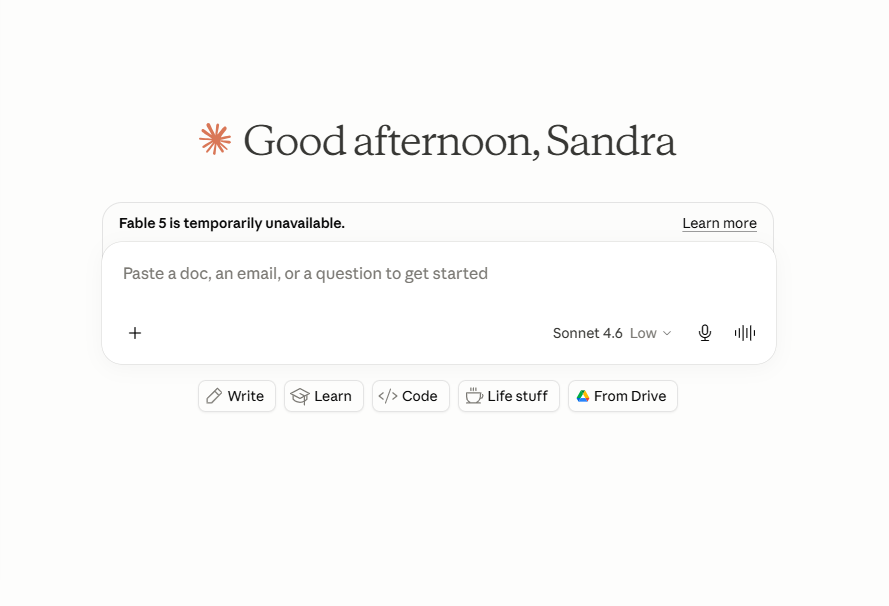
Sample book marketing prompts to try right now
Ready to put this into practice?
Here are prompts you can copy and paste into ChatGPT or Claude (the two AI tools I use the most), and customize with your own book details. I’ve marked each with which tool I recommend, though honestly, both work well for all of these.
Social media post
Good for: ChatGPT or Claude
Prompt: “Act as a book marketing expert. Write three Facebook posts to promote [YOUR BOOK TITLE], a [GENRE] book for [TARGET AUDIENCE]. The tone should be [YOUR DESIRED TONE]. Each post should be under 150 words and end with a gentle call to action. Avoid exclamation points and hype.”
Email newsletter
Good for: Claude (especially good at longer, structured content)
Prompt: “Write an email newsletter to my subscriber list announcing the launch of my new book, [BOOK TITLE]. My readers are [DESCRIBE YOUR AUDIENCE]. The book is about [BRIEF DESCRIPTION]. My voice is [FRIENDLY/CONVERSATIONAL/AUTHORITATIVE]. The email should be 200–250 words, open with a personal anecdote or question, and close with a clear link to purchase. Don’t use the word ‘journey.’”
Podcast research

Good for: Perplexity, which includes links to research results
Prompt: “I’m the author of [BOOK TITLE], A [GENRE/CATEGORY] book about [A FEW WORDS DESCRIBING IT]. Provide a list of 10 podcasts that could be interested in interviewing me. Don’t select the most popular or least popular podcasts – stay in the middle. When possible, provide contact information or a link to where I can find it online.”
Podcast pitch
Good for: ChatGPT or Claude
Prompt: “Act as a book publicist. Write a short pitch email to a podcast host whose show covers [PODCAST TOPIC]. I’m the author of [BOOK TITLE], a [GENRE/TOPIC] book for [AUDIENCE]. Suggest three specific episode angles I could offer in the pitch based on my book. Keep the tone professional but personable, and keep the pitch under 200 words.”
Book description for back cover
Good for: Claude (strong at nuanced, audience-aware writing)
Prompt: “Write a 100-word back cover description for my book, [BOOK TITLE]. It’s a [GENRE] book about [BRIEF SUMMARY]. My target reader is [DESCRIBE READER]. The tone should feel [WARM/SMART/GRIPPING]. Open with a hook that speaks directly to the reader’s problem or desire. End with one sentence that makes them feel like they need this book.”
Audience identification
Good for: ChatGPT (great for brainstorming and insight)
Prompt: “I’m the author of [BOOK TITLE], A [GENRE/CATEGORY] book about [A FEW WORDS DESCRIBING IT]. Describe my ideal reader in great detail and outline where I will find them online and in the real world. I’d appreciate specifics on their demographics.”
One more thing: always edit what you get
AI output is a starting point, not a finished product. Even a well-crafted prompt produces something that needs your eyes on it.
Read it out loud. Does it sound like you? Does it say something accurate and true about your book? Is there a word or phrase you’d never use?
Fix it if you need to. That’s not a failure of the tool — that’s just good editing. The goal is to spend less time staring at a blank screen, not to hand over your voice entirely.
Finally, use your manners. I always say please and thank you in my prompts. (But I also thank Siri when I talk to her on my phone….) Courtesy probably comes naturally to you anyway, and research shows it will improve your results.
Used well, AI tools can genuinely take the pressure off the parts of book marketing that feel like a chore and give you more time and energy for the writing itself.
Try using an AI tool to help you find blogs to visit for your virtual book tour. Learn how they work in my free download, “Virtual Book Tour Basics.”
Quick video tip about AI prompts for book marketing
FAQs about AI prompts for book marketing
1. Do I need to pay for ChatGPT or Claude to use them for book marketing?
Both tools offer free versions that are genuinely useful.
Paid plans unlock higher usage limits and additional features, but for writing social media posts, email copy, and pitches, the free versions will get you quite far. The system will tell you when you’ve hit the day’s limit on a free plan along with when it will reset.
2. What if the AI gets my book’s details wrong?
AI tools don’t know anything about your book unless you tell them in the prompt.
If you provide clear, accurate details — title, genre, audience, themes — the output will reflect them. If the tool makes something up or gets something wrong, simply correct it in a follow-up message: “Actually, the protagonist is a retired teacher, not a librarian. Please revise.”
The more you share about your book in your prompt, the better the response will be.
3. Will AI-generated content sound like me?
Not automatically — but you can get close.
The key is to be specific about your voice in the prompt (“friendly and direct,” “warm but not gushy,” “conversational, like I’m talking to a friend”) and then edit the output. I paste in a sample of my writing and say, “Write in a similar tone to this.”
Plan to spend a few minutes shaping the output. The tool handles the blank page; you handle the finishing touches.
4. Is there a difference between ChatGPT and Claude for book marketing?
They’re more similar than different for most marketing tasks.
In my experience, Claude tends to shine with longer writing tasks like email newsletters and book descriptions, while ChatGPT is excellent for brainstorming and generating lists of ideas quickly. I also use ChatGPT to help me think through a project’s process. The best approach is to try both and see which one you like working with and for what task.
Keep in mind that you can always take output from one and refine it in the other.
5. How do I get better at writing prompts over time?
Practice, mostly — but there’s a shortcut.
When you get a response you love, look back at what you asked and notice what you included. When you get something flat or off, look at what was vague or missing.
Keep a running document of your best prompts so you don’t have to reinvent the wheel every time. Over time, you’ll develop a personal prompt template that works reliably for your voice and your audience.
EDITED 6/24/26 TO ADD: I received an angry email from a subscriber who said this article encourages — even endorses — writing a book with AI. Wrong. If I wanted to communicate that message, I would have done so. You don’t have to read between the lines of my articles. But because others might infer the same thing as my disgusted subscriber, let me state unequivocably that nobody should write a book with AI. In the article I linked to above about using AI as a book marketing assistant, I make it clear that I don’t support that. And I explain why it’s a bad idea.
Have you tried using ChatGPT or Claude for your book marketing? Tell us what’s worked (or what hasn’t) in a comment!
Like what you’re reading? Get it delivered to your inbox every week by subscribing to the free Build Book Buzz newsletter. You’ll also get my free “Top 5 Free Book Promotion Resources” cheat sheet immediately!
