
3 common book marketing tactics that are useless (self-centered edition)
Discover 3 surprisingly common book marketing tactics that are useless, how they can hurt you, and what to do instead.
Honestly, I don’t like writing articles about the mistakes I see authors making online.
I’m not big on negativity. I see a half-full rather than a half-empty glass. I’m an optimist, not a pessimist.
But geeeeez. These mistakes practically jump off the screen and get tangled in my hair! They’re impossible to ignore… and they’re everywhere. Every. Where.
So, I’m crossing to the dark side today to discuss them. But I’m also hopping back to lightness and good and addressing what to do instead.
Book marketing tactics that are useless
Sometimes understanding what will support your book the most requires learning what will hurt it. It’s a variation on “do this, not that.”
DISCLAIMER: I like to include examples when I’m explaining things. When I’m learning, seeing what’s wrong and what’s right helps me better understand the concepts. Examples also show me the goal – here’s what it looks like when done properly.
You won’t see examples here, though, because it’s impossible to share screenshots or text that doesn’t identify people in some way. I know you understand how important it is to avoid embarrassing anyone.
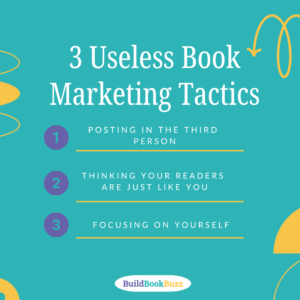
MISTAKE 1: Posting in third person.
Have you seen this, too? This approach is often used on or around publication day.
For example, announcing he has just published a book, “John Smith” writes, “John Smith is proud to announce he has just published Kanooter Valves and You: A Field Guide to Finding, Buying, and Using the Auto Part You Never Knew Existed.”
John goes on to explain how publishing this book fulfilled a life-long dream, etc.
It’s so awkward.
It feels stiff and formal. Did the author write the book the same way?
DO THIS INSTEAD
Be yourself.
Easy, right? You don’t talk in third person when you’re having dinner with a friend, so why do it on social media?
Imagine looking at the menu and saying, “Hmmmm, John’s in the mood for a good burger tonight.”
“Being yourself” means when announcing your book on social media, you write something more like, “I’m thrilled to announce I’ve just published a book, Kanooter Valves and You: A Guide to Finding, Buying, and Using the Auto Part You’ve Never Heard Of.” And so on.
MISTAKE 2: Presuming everyone is just like you.
Making marketing decisions based on your preferences could kill your book marketing.
I remember a conversation I had with a classmate as organizers were planning our class reunion. I noted that outreach seemed to be limited to Facebook, which meant many in our class wouldn’t know about it.
“What do you mean?” my classmate asked.
When I explained that not everybody uses Facebook, they said, “Oh! I didn’t know that! I thought if I used Facebook, everyone else did, too.”
Fortunately, this person didn’t have a marketing job.
If you wrote your book for people just like you, then it’s safe to make presumptions about shared experiences, attitudes, and so on.
If your target audience isn’t just like you, though, you don’t want to make all your marketing decisions based on your preferences and experiences.
Check your website branding
You’ll see this on websites. Male authors often have dark site themes – picture a black background with white text. It’s a traditionally male color scheme. Guys like it.
That works if you’re writing books for men. It doesn’t work if your audience includes a high percentage of women. A dark theme screaming male can feel exclusionary to women.
It tells them: There’s nothing for you here.
The more you remove yourself and the more you insert your ideal reader into your decision-making process, the more likely you are to create books, marketing content, images, and so on that will resonate with them.
DO THIS INSTEAD
Do the work to learn as much as possible about your ideal readers.
What do they like? What do they dislike? What experiences do they share? (And that’s just a start.)
The more you know about them, the more your book marketing messages will resonate with them – and the more likely you are to get your book in front of them because you’ll be showing up in the right places.
MISTAKE 3: Making it all about you.
This can decrease your reach when people disconnect because they aren’t interested.
Authors who do this typically use a marketing approach best summarized as “Look at me, look at me, look at me.” This tactic usually incorporates various forms of “I’m so special.”
Do you see these kinds of posts, too? Do they motivate you to buy? Me neither.
I need to know how your book will inform, entertain, motivate, or guide me. Your credentials for writing that thriller or business book are important, sure. But you need to sell me on the product, too.
The author who quotes themself is a variation of this – and an awkward one, too. (Read my article on why this doesn’t work and what to do instead here.)
DO THIS INSTEAD
It’s never about you. It’s always about your reader. Focus on what they want to know rather than on what you want to tell them. Sometimes, to communicate what they need to know, you have to give them what they want first.
If you write nonfiction, tell me what transformation I can expect after reading your book.
Are you a novelist? What kind of escape from reality are you offering me? What’s the story behind the story?
Give me something I can relate to.
And those image quotes I mentioned? Instead of quoting yourself, quote from the book and use the book title for attribution instead.
Quick video tip about common book marketing tactics that are useless
Make your reader the star
The author is the star of these examples. That works sometimes, just not all the time.
When marketing your book online, just flip that to make your reader the star most of the time.
Before posting, ask, “How does this help my ideal reader?” Your readers will thank you for that!
For more examples, be sure to read “3 author marketing mistakes to avoid in 2025 and how to thrive” and “3 author book marketing mistakes that will hold you back.” (I recognize that I seem to have a one-track mind, but acknowledging the problem is the first step to reform, right?)
Want to learn more about how to market your book effectively? Sign up for my new, free “5 Book Marketing Building Blocks” email mini-course and you’ll get a detailed explanation of one building block per day for five days! Start learning and taking positive action here.
What book marketing tip can you share with other authors? Tell us what’s working for you in a comment!
Like what you’re reading? Get it delivered to your inbox every week by subscribing to the free Build Book Buzz newsletter. You’ll also get my free “Top 5 Free Book Promotion Resources” cheat sheet immediately!

With I’d seen this about ten years ago.
https://bobsbooksite.com
Better late than never, Bob, right?
Sandy