
5 ways to make your book relevant to the media
Do you and your book deserve to be talked about in the press? Here are 5 tips for making your book relevant to the media.
When I ask authors what they’re doing to promote their books, they often say they built a website, or they’re posting about it on social media.
Rarely do they mention pursuing the free news media exposure known as publicity.
They aren’t trying to get their books mentioned in short news briefs or longer articles, and they’re not pursuing talk show and podcast interviews.
Because publicity’s impressive value isn’t on their radar, they’ve done nothing to make their book relevant to the media.
And yet, you don’t have to spend anything to get the kind of media exposure that’s at least 10 times more effective than advertising.
What’s more, you can snag book publicity even if your book was published years ago. It’s your book’s content that matters, not when the content became available for purchase.
It’s not as hard as you might think
You don’t need special skills or tools, either. You just need to know how the media works and what it needs from you.
A big piece of this is understanding how to make your book and its topic relevant to the press.
It comes easily for some, not so much for others. For the most part, becoming relevant and interesting requires paying attention to topics covered by the press and the sources they use for information.
Here are five tips that will help you become one of those sources.
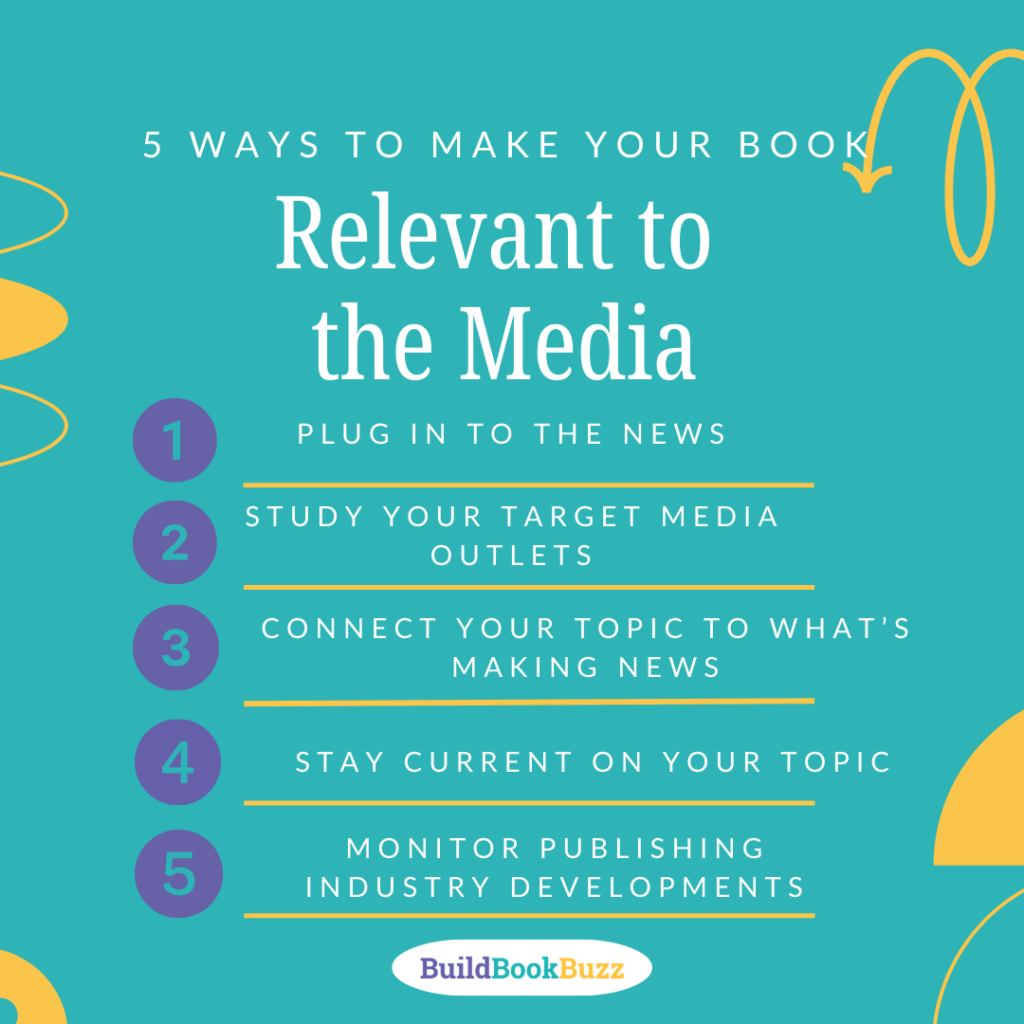
1. Plug in to the news.
Consume “real” news so you know what is and isn’t newsworthy.
The more you know about what’s out there, the better able you will be to understand where you, your book, and the topics or issues you write about will fit into the media landscape.
Follow what’s happening in your community, region, nation, and globally by reading at least one bona fide daily newspapers online. Watch the news on legacy networks. Listen to fact-centered, news-focused podcasts. This will not only deliver the facts, it will help you spot trends and hot topics.
On the flip side, pay attention to ideology-based alternative outlets so you’re exposed to conspiracy theories and opinions developed from feelings rather than facts.
This will help you see how controversial or counter-to-accepted information perspectives can generate publicity. Talk radio, in particular, likes controversy. And a counterintuitive media pitch can get attention.
2. Study your target media outlets for format and approach.
After you determine which media outlets influence your ideal readers, you want to study them so you understand the content they use.
What sorts of segments or stories do they run? How many sources do they use? Are the articles or segments short or long? Do they frequently site statistics from surveys or research?
Use an Excel file or Word table to make notes and look for trends that will guide how you approach each outlet.
3. Connect your topic to what’s making news.
Marketers refer to this as “newsjacking” — hijacking the news.
Monitor what’s making headlines and brainstorm ways to link your topic to the developments. There are perennial topics, like gun control, that present ongoing opportunities for both nonfiction and fiction authors who write about this.
As I write this, the U.S. is bombing Iran. Did you research anything related to this for your fiction or nonfiction? There could be a publicity opportunity for you with local media outlets.
It’s easier than ever to stay on top of the news, thanks to smartphone apps. Make sure you’re getting alerts so you don’t miss any opportunities.
If connecting your topic to trending topics is difficult for you, ask a friend to help you brainstorm connections between the range of topics in your book and what’s making news today and this week.
Do you and your book deserve to be talked about in the press? Here are 5 tips for making that happen.Click to tweet4. Stay current on your topic.
This will allow you to spot trends, and trends make good article/segment ideas.
It’s not hard to see how this applies to nonfiction authors, but it works for fiction, too.
Popular author Daniel Silva, best known for his long-running espionage series starring spy and art restorer Gabriel Allon, is an excellent example of an author at the cutting edge of their books’ themes. Any Silva fan (raising my hand 🖐️) knows more about the Israeli Mossad, Nazis, European art history, and Vatican inner workings and history after reading one of his books.
Thanks to his research, Silva is an expert on these topics.
Louise Penny’s The Black Wolf offers one of the most striking recent examples of authors who really know their sh*t. SPOILER ALERT for fellow Armand Gamache enthousiastes: Stop here if you haven’t read the book.
The book centers around a U.S. plot to annex Canada. How suprising, then, when just months after the book’s October 2025 release, newly inaugurated U.S. President Donald Trump threatened to annex Canada as the 51st state.
Fiction mirroring reality doesn’t happen by chance. It comes about when the writer researches the topic. Penny, a Canadian, is likely as qualified as many other sources to comment on U.S./Canada relations right now.
Pitch trend stories
Continuously monitoring topics you know best allows you to spot trends.
Use that up-to-date information to pitch a story or segment based on those trends that you can comment on as an expert resource. All the research you did for your book – plus your effort to stay current – provide the credentials you need.
Be open to this possibility. Don’t underestimate how much you know about the topics you write about, whether your book is nonfiction or a novel.
5. Monitor publishing industry developments.
Book publishing is evolving rapidly in multiple ways.
How people read is changing, as evidenced by the growth in audiobook popularity. So is who influences what we decide to read.
Diversity in book publishing is an ongoing issue. Do you have personal experience that can add to the conversation with the media?
Even what books look like is changing. Sprayed page edges revealing lovely graphics opposite the book’s spine is one of my favorite design trends. Does your book feature this attention-getting touch?
Do you write poetry? The Guardian and other sources report that poetry is more popular than ever. Pitch a local talk show host about why that’s happening. Organize a gathering of poets with your local bookstore and promote it to the press.
The more you know about publishing, the more you’ll be sought out for interviews and speaking engagements.
Start locally first, then regionally. You might be surprised at how easy it will be for you to become the local publishing industry expert — as long as you make the effort to follow industry developments.
Help build the story
As you make yourself and your book increasingly relevant to the media, understand that a major feature on a topic or trend nearly always uses more than one source.
Know that, and be prepared to seal the deal by offering others who can comment on the topic. Being prepared and realistic, and making it easier for a journalist to say “yes,” can make you and your book very, very relevant.
That, in turn, will generate the news media attention — the book publicity — that sells books.
Use the right tools
Getting and keeping your book title in the news does take some effort and thought. But what promotional effort doesn’t?
One of the easiest ways to connect with journalists on trending topics is by using three of the most popular tools for both journalists and expert sources like you: HARO (Help a Reporter Out), SOS (Source of Sources), and Qwoted. These free email newsletters list stories and segments journalists are working on and the types of sources they need to complete their assignments.
When you understand how to respond to their source requests effectively and appropriately, you’ll find that you’ll soon be quoted on trending topics — when it makes sense — more easily than you ever imagined.
Discover how to do that with PitchPro: Your Expert Response Toolkit, my collection of instructions, templates, cheatsheets, and worksheets that help ensure you write the best response possible.
Once you understand the type of information your targeted media outlets use and how they present that information, you’ll find yourself generating the types of article or segment ideas that get used. Then you’ll be snagging priceless media exposure for your book.
What’s one of your media exposure goals for this year?
(Editor’s note: This August 2019 article is now updated and expanded.)
Like what you’re reading? Get it delivered to your inbox every week by subscribing to the free Build Book Buzz newsletter. You’ll also get my free “Top 5 Free Book Promotion Resources” cheat sheet immediately!

Excellent information !!!!
Thanks, Aaron!
Sandy
Thanks for the fantastic tips, From a children author who’s making a difference in today’s youth.
I’m so glad you found them helpful, William!
Sandy
Thank you,especially for the affirmation that the research we do is an ongoing asset for publicity.
It is, Elizabeth, and not enough authors — novelists, in particular — use it that way.
Sandy
I’m long overdue posting on your newsletter. I appreciate the info you provide. All good stuff!